
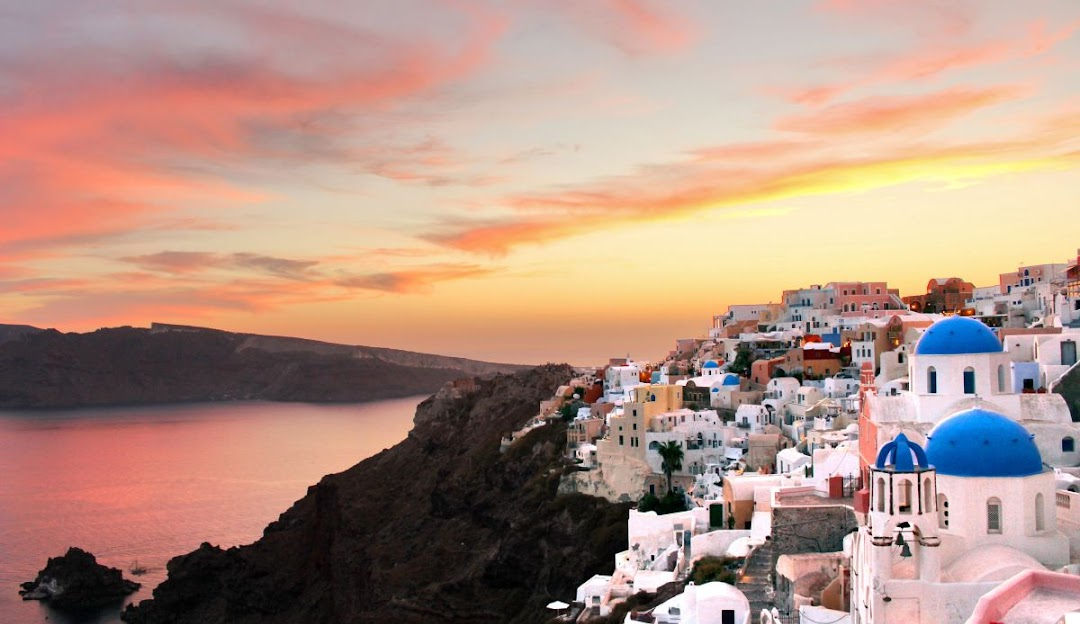
Leaving the Peloponesse and returning to the 21st century, we boarded a plane in Athens for the 1-hour flight to Santorini, where we would spend the next 3 days. Santorini is known to be a destination for honeymooners, so it was not surprising that our hotel went by the name Absolute Bliss. The name fit.
After checking in, we were led down countless steps to a beautiful suite with a canopy king bed, plenty of room, a great shower and a balcony overlooking a volcanic caldera and promising some of the famous Santorini sunsets. We were given a menu and told that breakfast would be delivered to our balcony/room each morning. Bliss.
Like most of the buildings on Santorini, our hotel was a whitewashed cubiform structure trimmed with the same blue for which Santorini’s church rooftops were famous. Similar to most of the other buildings, our hotel appeared to be holding on for dear life on the edge of this volcanic crater. The caldera was created by one of the worst earthquakes in human history (The Minoan Earthquake) in 1613 B.C.E. and had withstood thousands of temblors since. We were hoping that the slopes would hold back disaster a few more days.
One overall impression of Santorini is its verticality, yet we never saw an elevator; just plenty of steps. Not all of our walking was up and down, since there is a walking path that follows the rim of the caldera, connecting the two main cities, Fira (the capital) and Oia( pronounced ee-ah). Our hotel was in Imeroviglia, midway between these cities, which was convenient, since many of the shops and restaurants were located on this path. Imeroviglia was one of the high points of the caldera and is sometimes referred to as “balcony of the Aegean”.
We arrived late afternoon on the first day, acclimated to our surroundings and found a lovely restaurant close by and watched the sun descend over the Aegean. Right on script….
The next day, we took full-day tour of the island. We walked through Oia, at the northern end of the island, then drove down island to Megalochori, where we viewed an underground dwelling and some improbable vineyards. Santorini is famous for its white wines, but these “volcanic vineyards” are very different than any others we had seen elsewhere. (see photos)
We visited Red Beach (there are also Black and White Beaches) and moved on to the Prophet Elias Monastery, which is at the highest point of the island.
Our final destination was the excavation site at Akrotiri, where we saw the ruins of a Bronze Age community (part of the Minoan Civilization), destroyed by earthquake and volcanic explosion. What remained was preserved by layers of volcanic ash. I am still not sure we fully grasped that we were looking at houses where people were alive while Santorini was still intact as a round Aegean Island, before a whole civilization was destroyed and the present-day caldera formed.
Our only remaining scheduled event was a small-group sunset cruise by catamaran the following day. The tour starts at Akrotiri around 2 pm and sails along the inner coastline of the caldera before it deposits passengers at Oia after dark. There are scheduled stops for snorkeling or swimming and a stop at a natural hot spring. The trip does not guarantee a beautiful sunset or clear weather, but the crew does cook a dinner and serves wine.
We thought this trip might be a bust since it began during a thunder storm. We lucked out though, as the skies cleared after the first hour and we had a wonderful sail and a memorable sunset. It was a great way to spend our last night in Santorini.
SANTORINI PHOTO GALLERY
Click on an image to expand and start slide show


